Why QR code airdrops work at events
Live events are the ideal setting for token distribution. You have an engaged audience that is already interested in crypto or your project specifically. But handing out tokens the traditional way (collecting wallet addresses, building batch transactions, hoping people actually claim) creates friction for everyone.
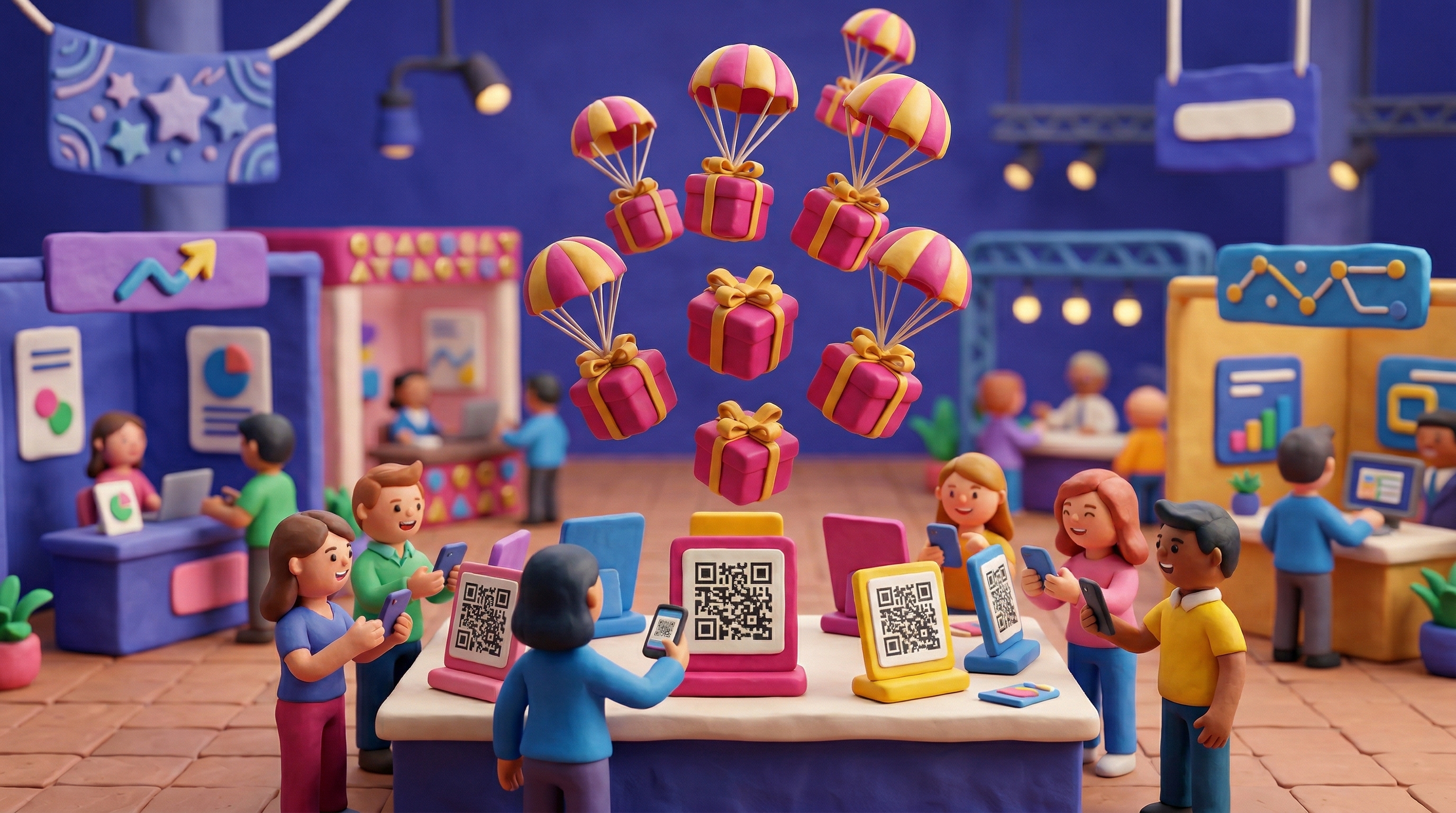
QR code airdrops flip this around. You print codes, people scan them, tokens arrive in their wallet. No forms, no email lists, no waiting. It works for newcomers who just installed their first wallet and for experienced users who have been in the Cardano ecosystem for years.
Here are five concrete ways to use this at your next event.
1. Proof of attendance tokens
The most straightforward use case. Mint a unique NFT for every attendee that proves they were at your event. Think of it as a digital ticket stub that lives on-chain forever.
Set up an NFT campaign with your event artwork, print QR codes on the badges or lanyards, and let people scan on their way in. Each scan mints a fresh NFT with sequential numbering directly into the recipient's wallet.
Zero friction for attendees. The token is a genuine on-chain record, not a centralized database entry. People keep it in their wallet as a collectible and a memory.
Set the wallet limit to 1 claim per wallet so each attendee gets exactly one token. Use the shared code mode if you want a single QR code displayed on a screen at the entrance.
2. Community onboarding packs
Conferences attract people who are curious about Cardano but have never used a wallet. A welcome pack with a small amount of ada gives them a reason to install one right now, not "later when I have time."
Create an ada campaign with a few ada per code. Hand out QR codes at your booth or include them in a welcome bag. When someone scans the code, they receive ada and immediately have something in their wallet to explore.
Receiving real value creates an instant connection. It turns "I should check out Cardano" into "I have a wallet with ada in it." Wallets like VESPR and Tokeo Pay let people skip the seed phrase backup on setup, so there is no 24-word barrier.
Print a short instruction on the flyer: "1. Install VESPR. 2. Scan this code. 3. Done." Keep it simple, because it really is that simple.
3. Hackathon participation tokens
Hackathons celebrate the winners, but what about everyone else who showed up and built something? A participation NFT recognizes their effort and gives every hacker a permanent on-chain record of the event.
Set up an NFT campaign, hand out QR codes to all participants, and each one mints a unique token. Organizers get it done in minutes, participants walk away with something meaningful.
Participants get an on-chain collectible that proves they were there and built something. It is a small gesture that makes people feel recognized, and it costs almost nothing to set up.
4. Sponsor activations and booth engagement
If you are sponsoring an event and want people to visit your booth, a QR code airdrop is a strong draw. Place a QR code at your booth that gives visitors a branded NFT or a small token reward. It gives people a reason to stop by and creates a direct touchpoint with your project.
You can track how many people claimed, which tells you exactly how much booth traffic you generated. No more guessing based on how many stickers you gave away.
Measurable engagement. You know the exact number of people who interacted with your booth, and they walk away with something tangible in their wallet, not a flyer they will throw away.
Use the shared code mode with a big QR code on a screen or poster. Set a wallet limit of 1 so people cannot claim twice. The real-time dashboard shows you the claim count throughout the day.
5. Scavenger hunts and gamified drops
Hide QR codes around the venue and turn token claiming into a game. Place unique codes at different locations: the main stage, the coffee area, the sponsor booths, a hidden spot only the curious will find. Each code gives a different token or NFT, and collectors try to find them all.
This works especially well with NFT campaigns where each location mints a different collectible. You can also combine it with ada campaigns where finding more codes means earning more.
People visit parts of the venue they would otherwise skip. It creates conversation and a shared experience among attendees. The campaign dashboard shows you which codes got claimed, so you can see which locations got the most traffic.
Set higher wallet limits (or no limit at all) so people can collect multiple codes. Use unique codes so each QR is one-time-use and cannot be shared via photo.
Making it work smoothly
A few things that make the difference between a great airdrop experience and a frustrating one:
- Test beforehand Run through the full flow yourself before the event. Create a test campaign on preprod, print a code, scan it with your phone. Make sure you know exactly what attendees will see.
- Recommend a wallet Do not leave people guessing. Pick one or two compatible wallets and tell attendees which one to install. VESPR and Tokeo Pay are the best choices for events because they skip the seed phrase on setup.
- Print big enough QR codes on tiny stickers are hard to scan. Aim for at least 3x3 cm for handheld codes. For posters or screens, go as big as you can.
- Have Wi-Fi If the venue Wi-Fi is unreliable, mention that people may need mobile data. The claim process is lightweight (a single API call), but the wallet app itself needs internet.
- Staff the booth Have at least one person available to help newcomers install a wallet and scan their first code. That five-second interaction makes a huge difference.
Ready for your next event?
Create a campaign and generate your QR codes in minutes.